Currently there is a global unprecedented call to united prayer and fasting unto the next Great Harvest! The prophet Amos stated plainly, “Surely the Lord God does nothing unless He reveals His secret counsel to His servants the prophets.” In our day, these prophetic voices include: Lou Engle with TheCall, Doug Addison with InLight Connections, Cindy Jacobs with Reformation Prayer Network, statesman Dutch Sheets, and others. Prayer and fasting precedes the latter rain of the Holy Spirit—and the time to take action is NOW! I encourage you to participate through whatever application the Lord gives you.
Prayer and Fasting Precedes His Coming
I remember well one of the first prophetic words I personally ever received and released. “As it was before the first coming of the Messiah, there was a seer named Simeon and a prophetess named Anna, so it will before the Second Coming of the Messiah Jesus. He will raise up a company of Simeon Seers and Anna Praying Prophets who will be waiting and watching, praying and fasting.” I believed that word when it came forth from my heart and mouth forty years ago and I believe it even more today! Let’s take a look at this principle from scripture.  When the time approached for Jesus, God’s promised Messiah, to be born, God again revealed His workings to certain of His servants who were waiting on Him quietly in faith, with their hearts tuned to His heart. He spoke to Mary and Joseph. He spoke to Elizabeth, the mother of John the Baptist, who discerned through the Holy Spirit that the child in Mary’s womb was the Son of God. He spoke to Simeon and Anna, two faithful, elderly servants in Jerusalem who, upon seeing Mary and Joseph in the temple to dedicate their firstborn son to God, recognized Him as the Lord’s Promised One. Today the Holy Spirit is speaking again thru a multitude of voices. Dreams and visions, prophetic promises and warnings are being issued in this strategic season. Whether it is the rocking voice of Lou Engle with TheCall or prophetic evangelist, Doug Addison with InLight Connections, a call to consecration with Prayer and Fasting is marching forward! Consider Cindy Jacobs with the Reformation Prayer Network or the voice of statesman Dutch Sheets, there is an usual united call to prayer and fasting unto revival to turn the tide in this nation and beyond declaring the Beginning of the Third Great Awakening. Add to that the West Coast Rumble spearheaded by Jerame and Miranda Nelson and now “California Dreaming” with Che Ahn and team. Or what about some next generation voices like Jennifer LeClaire with the Awakening House of Prayer in Florida or Jon and Jolene Hamill in DC! Oh and let’s add in some flaming apostles like Dr. Steven Matthews in Chicago or Ryan LeStrange based in VA. God is speaking loudly and clearly in this hour! It is a time of an unprecedented call to united prayer and fasting unto the next Great Harvest! Yes, prayer and fasting precedes the latter rain of the Holy Spirit!
The Church Is Restoring the Lost Art of Fasting
As a spiritual discipline, fasting has been a regular part of the lives of many Christians throughout most of church history. In modern times, however, it has fallen into general disuse among believers, particularly in the West. We have become so satisfied in our culture of plenty and so addicted to our “microwave mind-set” of instant gratification that fasting seems a quaint and archaic relic of a simpler and slower past that seems gone forever. But a remnant voice is arising saying, “No More!”  Many believers suffer from spiritual anemia because they have never learned the healthy benefits of fasting as a regular discipline. When properly understood and practiced, fasting is both a powerful weapon of spiritual warfare and an indispensable aid for entering into intimacy with God. It is also a key to releasing God’s presence in and through our lives. Because it helps us get in touch with God’s heart and mind, fasting also assists us in preparing ourselves for the outward ministry of sharing the fire of God’s love with others. It is time for the global Body of Chris to recover the lost art of prayer with fasting. One of the primary obstacles to overcoming this basic ignorance is proper teaching with a cutting edge. When enlightened teaching from the Word of God is combined with prophetic urgency we then have a force to be reckoned with. Many believers are just waiting for direction. They ache for a clear sound with regard to the biblical basis of fasting, why it is important, and how to do it. Well, I am here to say, “Let the roar to spiritual warfare with prayer and fasting arise in this hour!”
The Biblical Precedent for Fasting
The earliest mention of fasting in Scripture is the 40-day fast of Moses when God met with him on Mt. Sinai. During that time Moses received the Ten Commandments as well as instructions for building the tabernacle. The unique characteristic of this fast is that it was a supernatural fast. God divinely enabled Moses to go for 40 days without food or water! Later, after Moses smashed the stone tablets in anger over the Israelites’ sin with the golden calf, he observed another supernatural fast in the presence of God while the tablets were replaced. The Hebrew word for fasting is tsum, which refers to self-denial and voluntary abstinence from food. Many scholars believe that fasting began as a loss of appetite due to times of great stress and pressure, such as when Hannah, the mother of Samuel, “wept and would not eat” because of her barrenness. Fasting was a natural expression of human grief, such as when David fasted in sorrow over Abner’s death. Eventually, fasting evolved into a way for making one’s petition effective before God. When fasting was observed on a nationwide basis in Israel, it was used to seek divine favor, protection, or to circumvent the historical judgment of God. It thus became a normal practice for a group of people to combine confession of sin, sorrow, and intercession with fasting. The only required fast for all the Jewish people was the yearly fast on the Day of Atonement, when the high priest entered the Most Holy Place and offered sacrifices for the sins of the people. For their part, the people fasted for self-examination and to demonstrate remorse for their sins. By New Testament times, fasting was a familiar and well-established practice. Pharisees fasted twice a week. John the Baptist and his followers fasted regularly. Jesus Himself not only observed the yearly fast on the Day of Atonement as part of His Jewish heritage, but He also began His public ministry with an extended 40-day fast in the wilderness, where He was tempted by satan. Although He left little specific guidelines for His disciples concerning fasting, He did teach them that their fasting should be different from that of the Pharisees. They should fast in order to be seen by God rather than to impress men. With Jesus, fasting was not a matter of “if,” but “when.” Fasting was also a standard practice in the early Church, particularly before ordaining elders or setting people apart to a special task or ministry. Paul and other leaders of the early Church fasted regularly. In on own life, I was marked by the ministry of Mahesh Chavda, who has moved in every healing and miracle listed in the Gospels including the raising of the dead. He has also gone on two 40-day fasts every for over 30 years. Did you realize that there is a biblical precedent that sacrifice releases power?
There Are Many Reasons to Fast
Many Christians who know little about fasting assume that it always means going without food for an extended period of time. While that may be the most familiar image, it is only one of many different approaches. One of our primary scriptural frameworks is found in Isaiah 58:  “Is this not the fast which I choose, To loosen the bonds of wickedness, To undo the bands of the yoke, And to let the oppressed go free And break every yoke? Is it not to divide your bread with the hungry and bring the homeless poor into the house; When you see the naked, to cover him; And not to hide yourself from your own flesh? Then your light will break out like the dawn, And your recovery will speedily spring forth; And your righteousness will go before you; The glory of the Lord will be your rear guard.” In my research from over the years and with my own personal practice of fasting, I have discovered at least ten different models of fasting in the Word of God.
Ten Distinct Biblical Models of Fasting
- The Disciple’s Fast: to “loosen the bonds of wickedness” and free ourselves and others from addictions to sin. See Matthew 17:14-21.
- The Ezra Fast: to “undo the bands of the yoke,” to solve problems, and to invite the Holy Spirit’s aid in lifting loads and overcoming barriers that keep us and our loved ones from walking joyfully with the Lord. See Ezra 8:21-23.
- The Samuel Fast: to “let the oppressed go free,” to win souls and bring revival, to identify with people everywhere enslaved literally or by sin, and to pray to be used of God to bring people out of the kingdom of darkness and into God’s marvelous light. See First Samuel 7:1-6.
- The Elijah Fast: to “break every yoke,” conquer the mental and emotional problems that would control our lives, and return control to the Lord. See First Kings 19:1-8.
- The Widow’s Fast: to “divide [our] bread with the hungry,” care for the poor, and meet the humanitarian needs of others. See First Kings 17:8-16.
- The Saint Paul Fast: to allow God’s “light [to] break out like the dawn,” bringing clearer perspective and insight as we make crucial decisions. See Acts 9:1-19.
- The Daniel Fast: so “[our] recovery will speedily spring forth,” and we will gain a healthier life, or for healing. See Daniel 1:3-16.
- John the Baptist Fast: so that “[our] righteousness will go before [us],” and that our testimonies and influence for Jesus will be enhanced before others. See Luke 1:13-17.
- The Esther Fast: that “the glory of the Lord will be [our] rear guard” and protect us from the evil one. See Esther 4:13–5:2.
- The Bridegroom Fast: to prepare a people for the coming of the Lord! Yes, for the glorious return of the Lord Jesus Christ—our Bridegroom. The Spirit and the Bride say, “Come”…“Surely, I am coming soon.” Amen. Come, Lord Jesus! (Rev. 22:17a, 20)
We Fast Because We Love Him!
The sound of the trumpet summons the people together to fast and pray and weep before the Lord. Restoration comes as God renews His people by sending the early and the latter rain. The “latter rain” is the great outpouring of God’s Spirit on His people “before the great and awesome day of the Lord comes,” with a worldwide display of His glory. It is preceded by prayer and fasting by the people of God. Yes, these dedicated Christians might fast from many different perspectives but we go to war together with a lovesick heart passionate for His presence and longing for His return. I believe that we will still fast for all of the other reasons—power, crisis intervention, deliverance, etc.—but we will fast first and foremost because our heart is lovesick for our Messiah. Wasting our life on our Beloved isn’t even a question of great sacrifice for these lovers of God! They gladly waste everything on Jesus. We will fast and pray because we love Him and want to be near Him. We will sacrifice because, more than anything else in this life, we want Him! Amen. Come, Lord Jesus! Even so, come, Lord Jesus Christ!
Join Me in Prayer and Fasting!
James W. Goll
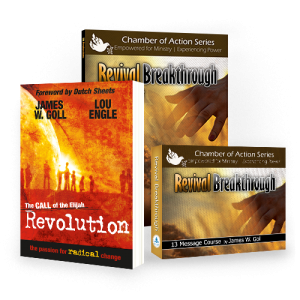 This article was adapted from portions of the Revival Breakthrough Study Guide by James W. Goll. To inspire you to believe and cry out for revival breakthrough in your own life, neighborhood, city, region, and nation, we have assembled the Revival Breakthrough Curriculum Kit, which includes the Revival Breakthrough 13 Session Class, The Call of the Elijah Revolution book, and the Revival Breakthrough Study Guide. Click Here to Buy the Revival Breakthrough Curriculum Kit. Buy the Bundle